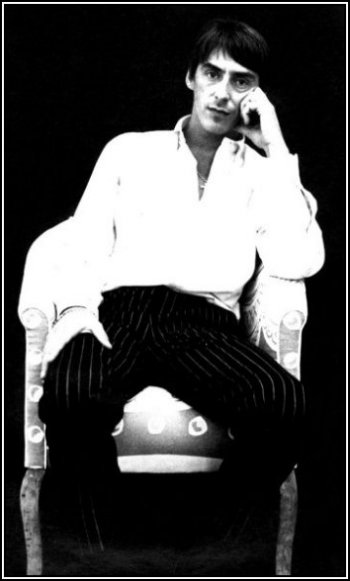
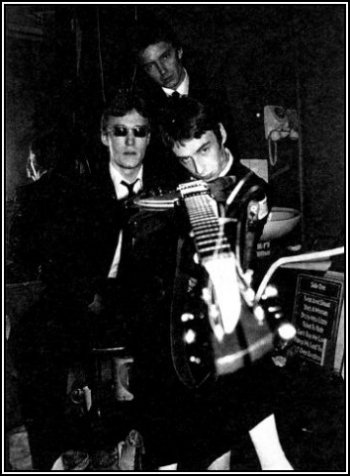
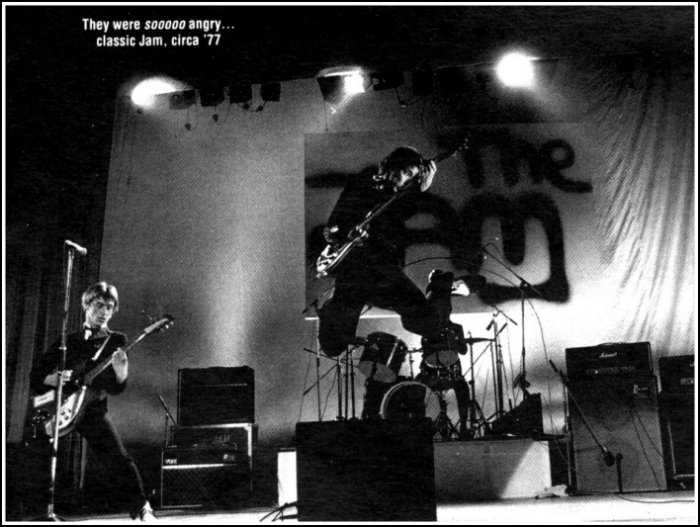
Its almost ten years since Paul Weller forsook the bread - and - butter thrash of The Jam for the cappuccino soul of the Style Council, so cue a rarity compilation. Extras, and the first chance in a decade to reunite the band and broach some taboos- Paul Weller shuffles in, all sheepish grin and nervous nod, and it's like time has stood still. From the David Jones and The Lower Third haircut, to the loafers, ankle length Levi's and the kind of casual sweater any '60s style freak would kill for, Paul Weller is still the walking Fashion Icon: The Boy About Town, the King of the Mods-born with dress sense in the same way that other people are born with plastic spoons in their mouths. You can count a few extra lines round the corners of his face maybe, but otherwise age has left those sharp features completely untouched. Skinny as a rake, the odds are he could still fit into the same suit he was wearing the night The Jam played their first real London show, in the now-defunct Nashville Rooms, at the tail end of 1976. Paul Weller has used up very nearly half of his allotted three score years and ten on this planet, but my guess is that his mental self-image is a dead ringer for the face he sees in the mirror while shaving every morning. There are a few differences. The Paul Weller who now sits opposite me, sipping tea and puffing his way through a pack of Bensons, appears to have mellowed considerably with the passing years. No longer the arrogant ball of pent-up anger and frustration, liable to spit and spark at the slightest provocation, he seems more relaxed and at peace with himself. Still a little terse, perhaps- but, chatting about his kids, he comes across as a lot more human than when we last met in 1980. Nevertheless, something tells me that the infamous Weller temper could still be lurking dangerously close to the surface, and that it might not be advisable to start digging around. This is Paul Weller's first 'official' interview in years, so let's get down to brass tacks. We're not here to talk about the usual PR things like his forthcoming Japanese tour, the new album he's just finished mixing and the record deal which is in the final stage of negotiation. We're here to talk specifically about The Jam, which-to all intents and purposes-has been something of a taboo subject in the Weller camp, during the ten years since the band played their last gig at Wembley Arena in 1982. The reason that Weller has broken cover after all this time, he is determined to make clear, is not because there is the remotest possibility of the band reforming. Rather, it's to do with Polydor, his old record company, which has decided to brighten up its Spring 1992 release schedule with a double album of Jam rarities. They're releasing 26 tracks, an assortment of B-sides, previously unissued material and original demos of songs that graced the Setting Sons and Sound Affects LPs. They've called it Extras and, far from being upset or miffed about the thing, Paul Weller is quietly proud of it. Even (one might venture) flattered. Which comes as something of a surprise. Weller (who has never exactly seen eye to eye with Polydor about anything) was distinctly lukewarm about last year's Greatest Hits package, even though the latter did shift 230,000 copies in the UK alone. Paul has always been slightly reluctant to let the past get in the way of his future perfect. "I must admit this is the sort of LP I hoped Polydor would do one day. he says. "It's far more interesting to me than a bunch of A-sides stuck on a record. I think you'd have to know quite a lot about The Jam to be really interested in some of the stuff that's on it. But I could be wrong." It's a well-documented fact that Weller is an avid collector-and occasional Pillager-of bootlegs and pirated cassettes of his own particular '60s heroes. He reveals, for instance, that the whole arrangement of The Jam's 1981 cover of The Who's 'Disguises' (which is included on Extras, since it was the B-side ( Funeral Pyre') was built around the a peat-echo guitar figure culled from Pete Townsend's original solo demo of the song, unearthed in a New York specialist shop. So he feels no qualms about exposing the bare bones of his own work to public scrutiny. 'Course not. If people are interested. it's great. I love that sort of thing. It demystifies the whole business. I've got tapes at home, which I picked up in the States, of Beatles demos and John Lennon playing 'Strawberry Fields Forever' for the first time on an acoustic guitar. You can tell he's only just written it because he keeps hesitating over the chord changes and getting embarrassed about it. That sort of thing is wonderful, 'cos you get so used to the excellence of the finished product that you forget where it all came from. If somebody told me there was an album out with some Small Faces' or Kinks' tracks on it I'd never heard, I'd go out and get it like a shot, however dodgy it might be." Extras is anything but dodgy. A perfect companion to the Hits collection, it's an album no true Jam aficionado will want to be without. Far from scraping the bottom of the barrel, it positively glistens with long-forgotten gems, as well as rough-cut diamonds and lodestones which were thrown away at the time and have never seen the light of day since. Tracks such as The Dreams Of Children', Tales Of The Riverbank', the minimally jazzy 'Shopping' (with Rick Buckler playing brushes, for Chrissakes!), the delicately acoustic 'Butterfly Collector' and bass player Bruce Foxton's 'Smithers Jones'- a brilliant reassessment of Cat Stevens' 'Matthew and Son'-will be (and already are) fondly remembered as the B-sides of 45s such as 'Going Underground', 'Absolute Beginners', 'Beat Surrender', 'Strange Town' and 'When You're Young'. Considering The Jam's standard singles sales base in the late '70s was a staggering 300,000 plus, a lot of people are going to have these tracks at home already, but in the loft, or the garage, or somewhere equally inaccessible. Extras is the first time they've ever been available on album. The real appeal of Extras lies in tracks such as: the red-blooded 1982 recording of 'Solid Bond In Your Heart' (which was to be a Top 20 hit a year later for The Style Council); superb but never-released covers of The Small Faces' 'Get Yourself Together' and James Brown's 1 Got You (I Feel Good)': a weird and wonderful monologue with psychedelic soundscape called 'Pop Art Poem' (originally released as a fan club flexi-disc); plus a clutch of Paul Weller's solo voice-and-guitar demos of impending Jam classics such as 'Burning Sky', 'Thick As Thieves', 'Saturday's Kids' and the epic 'Eton Rifles'. There's also an exhilarating version of The Beatles' 'And Your Bird Can Sing', which Paul recorded for fun one rainy afternoon in 1980 with Polydor staff engineer (and soon-to-be Jam and Style Council producer) Peter Wilson. He's particularly pleased that one has turned up again.
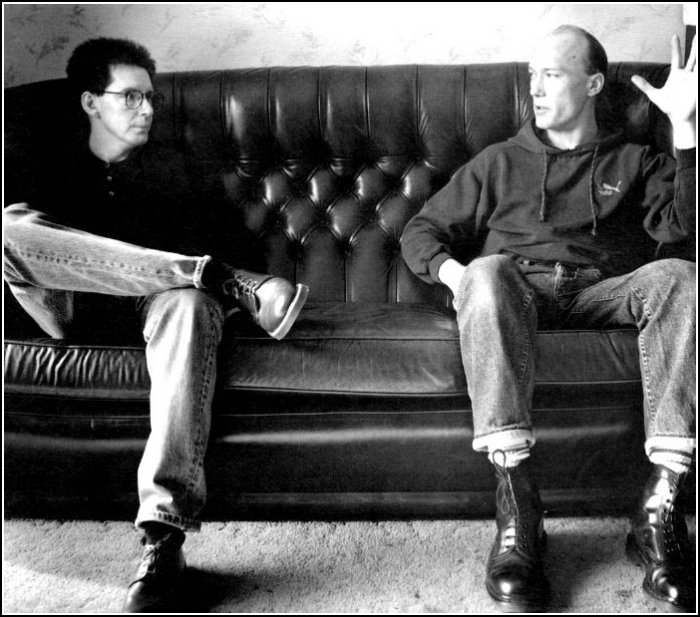
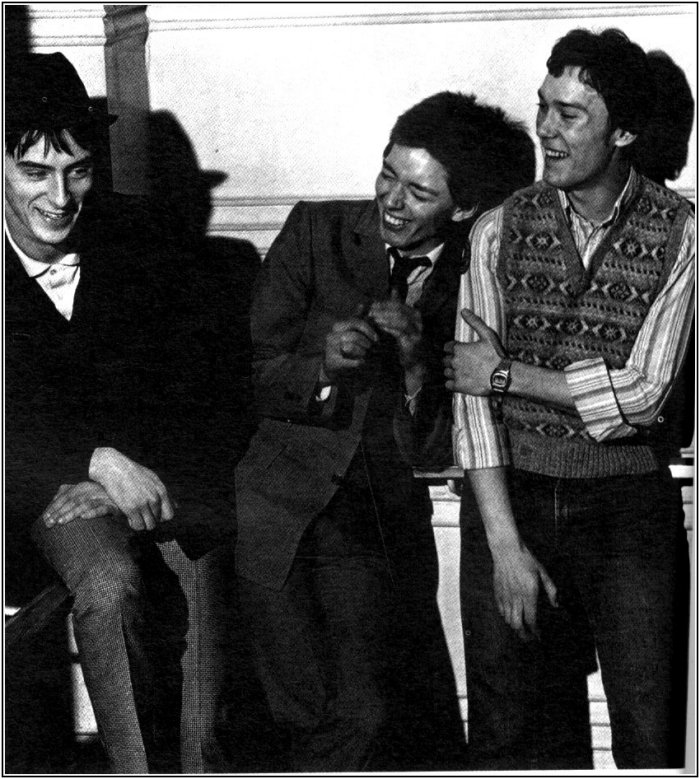
"Yeah, that's good, innit? We did 'Rain', too, round about the same time. In fact, we did loads of '60s things. We did a version of Sandie Shaw's 'Always Something There To Remind Me' and 'Stand By Me', with just me on guitar and bass and Pete on drums and organ. Those tapes have been lost, which might be a good thing really, 'cos I can't remember how good I they were." So where were former stalwarts Bruce Foxton and Rick Buckler while all this was going on? "I dunno. Having a few days off, probably. Whenever we weren't touring or making records I'd be demoing at Polydor. It felt like I was there all the time. The studio was in their old Stratford Place building, off Oxford Street. When we did those '60s tracks I was supposed to be demoing new songs for the Sound Affects album, but I only really had That's Entertainment' and a couple of others written. So Pete and I spent the rest of the time fucking about. "What really interests me, though, are the songs that never got used, the unfinished things like 'Anyone In The World' and 'Hey, Mister'. I'd forgotten all about them. And the demos of 'Burning Sky' and Thick As Thieves'! I can't remember where or when I done them at all." The impetus for rarities came from former Polydor staffer Dennis Munday, an original '60s Mod, who somewhat arbitrarily inherited joint A&R and marketing responsibilities for The Jam when the man who signed them, New Zealander Chris Parry, left to set up Fiction Records with The Cure. That was in 1978, immediately prior to the release of the 'Down In The Tube Station at Midnight' 45 and All Mod Cons LP. It was make or break time for the young Jam, who had yet to enjoy a Top Ten single and whose second album This Is The Modern World had been panned by critics. Munday freely admits he saw himself in 19-year-old Paul Weller, believed passionately in The Jam and swiftly earned both trust and respect by fighting tooth and nail on their behalf with a record company whom, he claims, never fully appreciated the true value of the band they had signed. And possibly still don't. "I reckon two or three bands come up every decade who have an effect on pop and rock music which lasts forever-the Jam are one of those bands," says Munday today. "And I like to think I recognised it almost immediately-unlike a lot of people at Polydor who I'm certain never thought the band had any longevity. I kept personal copies of all the demo tapes and rejected mixes that passed through my office, and at home I've got hours of stuff all carefully filed away on cassette. I've also got live recordings from every tour they ever made of Britain. But most of them aren't really useable. "When we got the go-ahead from Polydor at the end of 1990 to start researching this album fully, I discovered that, in many cases, what I'd got was all that was left. The original multi-tracks have simply gone missing. Nobody knows where they are. That's criminal, if you ask me. Master tapes must surely be one of a record company's greatest assets. To admit they've lost them is like the Bank of England saying they've lost some gold!" Munday sought to put together an album from whatever could be salvaged, which would preserve The Jam's much-prized credibility. That same credibility which, years ago, he had recognised as one of the key elements to the band's continued success. "We were able to remix a few of the Extras tracks with Peter Wilson, but basically I wasn't worried if the recordings were a little iffy, as long as the songs and the performances were up to scratch," admits Munday. "They had to retain the qualities that people remember, which made The Jam such an important band, and the reason why they will continue to sell records ad infinitum, if their memory is treated with proper respect. "It's easy to forget just what a successful band the Jam were. In five years they not only had four Number One singles-which is more than Elton John has managed in his entire career-but those records consistently sold in the sort of numbers that would keep them on the top of the charts for months and months by today's standards. "And Paul was such a prolific song-writer, too. He never stopped delivering great material. As soon as we'd got an album finished he'd be writing new songs for the next single. You forget that things like 'Funeral Pyre', 'Absolute Beginners', 'Beat Surrender', 'When You're Young' and 'Strange Town' were never put on any albums. I think we released 16 singles in five years: they weren't all great, but there certainly wasn't a duff one, which is a pretty major achievement in my book." The release of Extras has prompted Paul Weller to reassess his own role in The Jam. There's good reason to believe that, towards the end, he considered the band as little more than a one-man show, and Extras might reinforce such a theory, given the overall strength of the writing, and the power and passion exhibited in the solo demos of 'Eton Rifles', 'Burning Sky' and Thick As Thieves'. The truth of the matter, as Paul now admits, is that such demos really were few and far between. "I believed then, as I believe now, that if a song still sounds good when you sit down and play it with just a voice and a guitar then you know you've got a good song. With 'Eton Rifles' I certainly did sit down and figure it all out before I played it to anyone. And I can understand how it might have been tough on Rick and Bruce when I presented them with a song like that and virtually told them what to play. It must have been especially frustrating for Bruce because he had such a distinctive style. But 'Eton Rifles' was an exception. Most of the time all I had were rough ideas and fragments, and we'd hammer them out together, with everybody contributing ideas." That is certainly how drummer Rick Buckler remembers it. "In The City, the first album, was essentially a studio recording of our live set. After that, though, most of the arrangements which made it onto record were worked out between the three of us. Things like 'Pretty Green' grew out of Paul picking up on a rhythmic idea that Bruce and I were messing about with one day. Or else we'd experiment with some of Bruce's bass lines, to link sections for two different songs which weren't quite working and turn them into one that did. That sort of thing. You may think this is sour grapes, but my feeling is that Paul needed Bruce and I to be there to bounce ideas off. He fed off the tension. Once he took sole control of things, I think a lot of the fire went out." Weller himself can hardly be expected to concede this last point. Not with Style Council masterpieces like 'Long Hot Summer' and 'Speak Like A Child' to his credit. Nevertheless, Extras has prompted h admit further fallibility and, somewhat belatedly, to acknowledge the role played in The Jam's success by the producers-in particular, Vic Coppersmith-Heaven, who guided the band from their very first recordings to 1980's Sound Affects LP. "I think bands have a tendency to give themselves all the credit for what goes onto a successful record," says Weller. "I know we did. It's only now that I realise we'd have been thrashing about in the wilderness if Vic hadn't been there". Today, Coppersmith-Heaven lives in the wilds of Gloucestershire, working as a trustee for the Earth Love Fund, which seeks to mobilise the support of musicians and artists for a variety of different ecological campaigns. When we spoke he was putting the finishing touches to the soundtrack of a forthcoming Central TV programme about endangered species. Back in 1977, as plain old Vic Smith he already had major engineering credits on Cat Stevens, Rolling Stones and Joe Cocker sessions, when Polydor A&R man Chris Parry invited him to co-produce The Jam. The brief for both of the first two albums was simple: make them loud, fast and cheap. Preferably in reverse order. The results were good. Both In The City and This Is The Modern World were almost as exciting as the band's live shows. But they weren't awesome. Vie remembers the turning point came with 'Down in the Tube Station at Midnight', the track which was to close All Mod Cons and take The Jam up to Number 13 in the singles chart of October 1978. "I had to stop Paul from throwing the song away on a number of occasions. He was very frustrated with it because, although he had it fully written, we had difficulty in discovering an effective arrangement for it. After I'd seen the completed lyrics I knew instinctively that this could be both a classic Jam track and an important crossover song for the band. The Mod Cons sessions were something of a turning point, when we started experimenting with things like over dubbed guitars, percussion and sound effects, without sacrificing the basic integrity of the three piece sound. Once The Jam were confident with the idea of overdubbing there was no stopping them" Although Copper-Smith Heaven had no hand in any of the demos featured on Extras, he does remember the final mix of "Eton Rifles" as being something of a nightmare. "On the very last night of recording in the Townhouse, after all their mates had been in to sing along on the choruses, I threw up a very quick monitor mix, just so that we'd all have something to take home to listen to. It took ten minutes and it was exciting, capturing all the excitement and all the feeling that had gone into the sessions. But there were a few cues missed here and there; backing vocals and organ overdubs weren't quite loud enough-the sort of thing you expect to be wrong with a monitor mix. We moved to RAK studios to complete the album, and even though I went back to the Townhouse and tried everything I knew, I just couldn't recapture the atmosphere and excitement of that original rough tape. "I tried the near impossible and ran it against the multi-track, and wherever there was a short section which needed repairing, where a keyboard could have come in or a voice should have been a little louder, I'd make a new mix, dubbing two-track to two-track to add the missing elements, and then cut it back into the old one. This was before there were such things as synch codes to lock two tape machines together. So it all had to be done by ear and eye, with scissors and splicing tape. The finished master was made up of so many tiny edit sections it looked like a patchwork quilt. Suddenly and somewhat acrimoniously, at the end of 1982 Weller sacked his ex-school chums Bruce Foxton and Rick Buckler. "I'd just had enough," is all he'll say today. But talk to Dennis Munday or Peter Wilson, two of Weller's closest associates at the time, and the impression you'll get is that Paul wanted to progress musically, but didn't feel his long-term Jam cohorts would be up to the task. This, of course, is old news to Bruce Foxton and Rick Buckler. Even after ten years, in which they have both forgiven if not forgotten, it's a bitter pill which Foxton, in particular, still finds a little hard to swallow. "It was a real shock when it happened," recalls Bruce. "We knew Paul wasn't happy, and I was expecting him to suggest taking a break for six months or a year so he could concentrate on getting his studio and record label together. Then he'd come back refreshed, and we'd pick it all up again. After all, right from the start, when I first joined the band from school in 1973 the idea was always to be big. And despite the at that we were massive in Britain, the US was only just beginning to open up for us, and we still had a lot of work to do. "The trouble was that Paul never discussed what he was feeling with us", explains Foxton. "And he hasn't done since. I've only met him once since we split up, although I've tried to contact him several times, which makes me sad. Maybe he was right: maybe we couldn't have persevered with the new direction he was moving in. But I always thought Rick and myself were amiable enough chaps to give it a go if he'd asked us. But he never did."
Extras offers no answers, only more twists to the tale. Some of the last recordings The Jam ever made are on this album, including 'Beat Surrender' B-side 'Shopping', and the putative master of 'Solid Bond In Your Heart', produced by Peter Wilson but subsequently rejected after extensive editing. Could The Jam have made the transition? Well, 'Solid Bond' may not be perfect, and is undoubtedly harsher than the Style Council's hit version, but the rhythm playing of Foxton and Buckler doesn't sell it appreciably shorter than Paul Weller's guitar work. 'Stoned Out Of My Mind', on the other hand, is a superb example of updated dewy-eyed '70s soul. 'Shopping', complete with 'Frisco flute solo, is a clear supper-club jazz pastiche, and even if his tongue is slightly in his cheek, Rick Buckler's brushwork, in particular, is very nicely stylised. Less said about the cover of Curtis Mayfield's 'Move On Up' the better, though. |