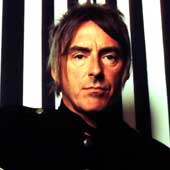
Throughout his career, Paul Weller has dabbled in cover songs, but they were usually delegated to European-only B-sides. Not anymore. The former Jam and Style Council frontman's latest solo effort, Studio 150, is composed entirely of re-workings of other artists' tunes -- some well-known (Bob Dylan's "All Along the Watchtower"), some obscure (Noel Gallagher's "One Way Road"). Weller used Studio 150 to "recharge his batteries," and, after he and his band -- guitarist Steve Cradock, bassist Damon Minchella and drummer Steve White -- spend the winter touring their native Britain, he plans to get started on original material. What made you decide to record a covers album?
Well, I've been talking about doing it for ten or twelve year and never got around to doing it. And now it seems as good a time as any. Also, I needed a break from writing.
Besides, you've always done covers for B-sides . . .
When we've done covers in the past, it's just been us sort of jamming on a favorite tune after we've finished the sessions. This album was more thought about. They're not my all-time favorite songs, but they're good songs -- songs that I thought we could do something else with.
Any songs you attempted, but didn't make the cut?
The only other tune we tried, which didn't work out, was "Gimme Shelter" by the Stones. We've done about eighteen songs altogether: twelve on the album, and the other six we'll use for B-sides and stuff.
What are the B-sides?
We did a Lovin' Spoonful song called "Coconut Grove"; "Corrina" by Taj Mahal; "Don't Go to Strangers" by Dinah Washington; "Let It Be Me," which is an old French tune; "Needles and Pins" [by Sonny Bono and Jack Nitzsche, a 1964 hit for the Searchers]; and "Family Affair" by Sly and the Family Stone.
Some of the renditions on Studio 150 stay close to the original, while others differ -- how did you decide?
I think the ones that are closest to the originals are probably ones that are our favorites, and songs I knew well.
Neil Young's "Birds" sticks pretty close.
I think we brought out a more gospel thing in it -- I could always hear in the melody or chord shapes, a kind of church-y thing in it. Things like Aaron Neville's "Hercules" we were playing in the set ten or twelve years ago, so we're quite familiar with that song.
You named the album after the studio where you recorded the album. Tell me about the place.
It's in the center of Amsterdam. It's not state-of-the-art, just a nice, little funky place, and we had a fantastic engineer, a Dutch fellow called Joeri [Saal], and it was kind of low-key, in a nice way. It was our little home for that period of time. It worked out well for us, but I suppose it was nice just to feel that we were going away from England, and doing something special.
With such a large amount of songs to choose from at this point of your career, how do you choose a set list when you play live?
I suppose I do tend to pick songs that I can still relate to, if we're talking about old songs -- Jam, Style Council -- even though I realize there are probably other songs people would like to hear. Unless I can find a personal connection with them, I find it hard to play them. Otherwise, it's just like going through the motions.
So it has nothing to do with what you think the fans may want to hear?
Well, for instance, people would love to hear [the Jam's] "Going Underground." I like the song, but it's not "of the time" for me. I mean for me, the words are still relevant, but as a personal thing and as a musician, it's gone for me.
What was the first album that moved you?
The first album I ever bought was Sgt. Pepper by the Beatles. I bought it a year after it came out -- it took me a year to save up for it. I don't know if it remained my all-time favorite, but at the time, I would just play it over and over again. I thought it was amazing. Up until that time, I probably bought a couple of singles -- my mum had been buying singles, I suppose -- so to have this album, to have the sleeve and to read the lyrics, was just amazing to me.
Let's close with some politics: There's much talk of an anti-Bush sentiment in Europe. How is he perceived in England?
I would say pretty much "anti-," yeah. I think people are just really disappointed, disappointed with Blair as well, who's just like Bush's lapdog. I think everyone's just disillusioned with politics in our country, and it must be the same in your country. To me, there's this false veneer of democracy -- I suppose we have our say and our votes and all that, but to no avail really. I mean, they made their minds up that they wanted to march into someone else's country, and they're going to do it, with their agendas, and that's that. There were millions of people out on the streets in America and all over the world last year, and it didn't make any difference.
And what about Blair?
He's on his way out, I think. He'd be very, very lucky if he survives much longer.